-
Shopping cart is empty
-
x



-
Shopping cart is empty
-
x
-
-
-
Shopping cart is empty
-
x
For free delivery are missing -,--Free delivery!Sum 0 €Price includes discounts -
- Categories
-
AesPLLA 365mg
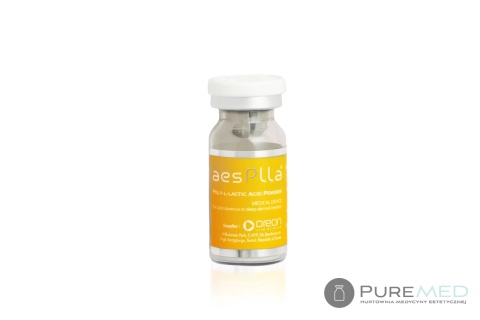
AesPLLa 365 mg is a collagen stimulator based on poly-L-lactic acid, designed to gradually improve skin volume, firmness and smoothness.
| Reviews | |
| Shipping within | 24 hours |
| Shipping price | The Lack Of |
Telephone order: 697197052
AesPLLA 365mg – Korean PLLA biostimulator for deep skin regeneration
An advanced collagen stimulator based on biodegradable poly-L-lactic acid. Restores tissue volume, densifies the skin and reduces wrinkles — with results lasting up to 3 years.

- What is AesPLLA 365mg?
- What is poly-L-lactic acid (PLLA)?
- How does AesPLLA work – mechanism of action
- How does PLLA differ from an HA filler?
- Composition and the role of each ingredient
- Indications and treatment areas
- Product preparation and injection technique
- Results and how long they last
- Contraindications
- Package contents
- FAQ – questions and answers
Biostimulation
Stimulates fibroblasts to intensively synthesise collagen and elastin in the deep layers of the skin.
Volume and contour
Restores lost tissue volume and reshapes facial contour in a natural way.
Up to 3 years of results
Long-lasting results of up to 3 years through gradual biostimulation of the skin's own collagen.
What is AesPLLA 365mg?
AesPLLA 365mg is an advanced Korean tissue stimulator based on poly-L-lactic acid (PLLA), intended for professional use in aesthetic medicine procedures. The product was designed for comprehensive regeneration of mature skin — it rebuilds volume, densifies the skin and smooths both fine expression lines and deeper wrinkles. The CE1434 certificate confirms compliance with European safety and quality requirements for medical devices.
What is poly-L-lactic acid (PLLA)?
PLLA (poly-L-lactic acid) is a biocompatible and fully biodegradable synthetic polymer that naturally breaks down in the human body into water and carbon dioxide, leaving no residue. It has been approved by the US FDA as a safe, small biodegradable polymer particle used in medicine — from surgical sutures to resorbable implants.
In the context of aesthetic medicine, PLLA acts as a long-term biostimulator: polymer particles, once injected into the deep layers of the dermis, trigger a controlled tissue response that gradually stimulates fibroblasts to increase collagen production. The effect is not immediate — it develops progressively, but is far more lasting than with classic HA fillers.
How does AesPLLA work – mechanism of action
After injection into the deep layers of the dermis, PLLA microparticles work in three stages:
- Stage 1 – inflammatory response (1–2 weeks): PLLA particles trigger a controlled, physiological inflammatory reaction — the body recognises the polymer as a foreign body and sends fibroblasts to the injection site.
- Stage 2 – stimulation of collagenogenesis (4–12 weeks): the incoming fibroblasts intensively produce de novo collagen — the skin's own natural collagen, which densifies the dermal structure and restores its volume. The first visible results appear around 4 weeks after treatment.
- Stage 3 – biodegradation and consolidation of results (up to 3 years): PLLA particles gradually degrade into lactic acid, which the body metabolises naturally. The newly formed collagen, however, remains in the tissue, maintaining results for 2–3 years.
How does PLLA differ from an HA filler?
- HA filler – works immediately and mechanically: it fills tissue space, increases volume, but does not stimulate the skin's own collagen production. Results last 6–18 months.
- AesPLLA (PLLA) – works biologically and gradually: it does not fill mechanically, but stimulates the skin to rebuild its own collagen. The effect builds over several weeks and lasts up to 3 years. This is a regenerative treatment, not a volumising one.
PLLA and HA fillers can be successfully combined as part of a comprehensive rejuvenation plan — they do not compete with each other but work complementarily at different tissue levels.
Composition and the role of each ingredient
Each AesPLLA 365mg vial contains 365 mg of powder, including:
- L-polylactic acid (PLLA) – 150 mg — the active substance responsible for collagen biostimulation. A biodegradable polymer with full biocompatibility, approved by the FDA.
- Sodium carboxymethylcellulose (CMC) – 90 mg — an excipient that stabilises the product, improves its rheological properties and facilitates even distribution of PLLA throughout the tissue after injection.
- Mannitol – 125 mg — a sugar alcohol that prevents PLLA particles from clumping during lyophilisation and storage, while also providing a protective effect on tissue at the injection site.
INCI: Poly-L-lactic acid, Sodium Carboxymethylcellulose, Mannitol
Indications and treatment areas
- skin laxity and loss of density in patients over 30 years of age,
- deep furrows and folds, including nasolabial folds and marionette lines,
- fine and medium-depth expression wrinkles,
- soft tissue volume loss in the face, neck and décolletage,
- hands — restoring volume and skin density,
- scar regeneration, including post-acne scars,
- buttock and breast shaping (body volumetric treatments).
Excluded areas: the eye area.
Product preparation and injection technique
Preparing the solution:
- Dissolve the contents of the vial in 5 ml of saline solution (0.9% NaCl).
- Leave to stand for a minimum of 3 hours to allow full hydration of the PLLA particles — this step is critical for obtaining a homogeneous solution and ensuring the product works correctly.
- Optional: add 1 ml of 2% lidocaine to reduce discomfort during injection.
- The prepared solution (9 ml from one vial) must be used within 72 hours of opening and stored in the refrigerator.
Injection technique:
- Injection layer: deep layers of the dermis.
- Recommended technique: linear (retrograde) or cross-hatching.
- Recommended needle/cannula size: 26G.
- After treatment: massage the injection area 3 times a day for 3–5 days — this ensures even distribution of PLLA particles throughout the tissue and minimises the risk of nodule formation.
Results and how long they last
- After 4 weeks — first visible results: improved skin tone and hydration, beginning of densification.
- After 2–3 months — full collagenogenesis effect: marked skin densification, wrinkle smoothing, restored contour.
- Up to 3 years — duration of results depending on individual skin characteristics, age, lifestyle and the number of sessions performed.
Contraindications
- pregnancy and breastfeeding,
- active inflammation or infection at the injection site,
- autoimmune diseases,
- tendency to hypertrophic scarring or keloids,
- hypersensitivity to any component of the product,
- blood clotting disorders or use of anticoagulant medication (medical consultation required),
- eye area — the product is not indicated for this zone.
Package contents
- 1 x vial of lyophilised powder 365 mg (PLLA 150 mg + CMC 90 mg + mannitol 125 mg)
- From 1 vial, after reconstitution in 5 ml of saline, 9 ml of ready-to-inject solution is obtained
- CE1434 certificate — medical device
FAQ – questions and answers
How does AesPLLA differ from Sculptra?
Both products are based on PLLA and work by a similar collagen biostimulation mechanism. AesPLLA is a Korean alternative available through medical wholesalers, with a comparable composition (PLLA + CMC + mannitol), certified CE1434.
When are the first results visible?
The first visible results appear around 4 weeks after treatment. The full collagenogenesis effect develops over 2–3 months and lasts up to 3 years.
How many treatment sessions are needed?
Typically 2–3 sessions are recommended at 4–6 week intervals. The number of sessions depends on the individual condition of the skin and the specialist's assessment.
Why does the product need to stand for 3 hours before treatment?
The PLLA particles must fully hydrate in the saline solution — insufficient hydration time leads to a non-homogeneous solution, which can cause nodules in the tissue and reduce the effectiveness of the treatment.
Can AesPLLA be combined with an HA filler or botulinum toxin?
Yes, PLLA and HA fillers work at different tissue levels and complement each other excellently. AesPLLA treatment can be safely combined with botulinum toxin and other aesthetic medicine procedures, provided appropriate time intervals are observed between treatments.
Why is post-treatment massage necessary?
Massaging the area 3 times a day for 3–5 days after treatment is essential — it ensures even distribution of PLLA particles throughout the tissue, preventing nodule formation and guaranteeing a homogeneous biostimulation effect.
This product may only be used by professionals. By purchasing this product, you confirm that you are a doctor or cosmetologist trained in aesthetic medicine.
Manufacturer details
PRP Science Co., Ltd.
#403, Kyeong-Won Building Samsung-ro 149-gil 32, Gangnam-gu
149-gil 32 Seul
South Korea
790 875 265
info@odamedical.pl
- Manufacturers

















































545.00